Showing posts with label Engineering. Show all posts

Friday, August 13, 2010

The Other Rear Window...

...and get your minds out of the gutter.

The view NW from my office is the previously-posted view of the new construction at the WTC site. The view due west (from the window closest to my desk) is the demolition of the Banker's Trust Trading Building / Deutschbank Building on Liberty Street.

The overview (click to engorge):

The tall building dead center and the similar one to the right are World Financial Center 1 and 2, on landfill west of the WTC site that was created with the excavation spoil from the WTC. The gothic building in front of WFC1 is 90 West Street, the building that was most heavily damaged on 9-11 that was repaired rather than demolished. The "construction" in front of 90 West is the demolition of Deutschbank. This was a 50-story building and is now down to about 6 stories.

The concrete is broken up, the steel is burned off, and the dumpsters full o' crap are hoisted down to the street. This building received some serious structural damaged on 9-11 - a chunk of steel falling from the south tower gouged Deutschbank's north face for about eight stories, cutting a dozen beams and destroying one column - but that was repaired by 12/01. The glass facade was pretty much shattered, and this allowed rain in, and the interior of the building turned into a huge mold farm. Since (a) no one really wanted the building, (b) Deutschbank was able to claim it as an insurance loss, and (c) it's in a prime spot for redevelopment, it's coming down.

The geniuses first hired to demo it managed to create an interior maze (the steel fireproofing is asbestos, so the whole building had to be abated) and cut the standpipes, leading to the deaths of two firefighters in the summer of 2007. The current demo contractor is being ever so careful.

Thursday, August 5, 2010

Reuse and Zombies

I'm not going to be shown up by a shambler.

In my business, you hear a lot of nonsense about old buildings: "They don't build them like they used to." "What a piece of crap." "It doesn't meet code."

Here's the thing about old buildings: they exist independently of our opinions of them. Codes change, but physical reality does not. About fifteen years ago, the U.S. wood code (AKA the National Design Specification from the American Forest & Paper Association) revised downward the allowable stress on nearly every commonly used species and grade of construction lumber. The code had been based on research performed using 2" x 2" pieces, which, it turns out, are not statistically representative of the 2x10s and 2x12s used in construction. A house that I designed before the code change would contain beams that, according to the new code, don't work. Did the house become unsafe because the code changed?

This has happened before. Cast iron columns were common in the 1800s and now are excluded from structural use. Ditto unreinforced structural concrete and concrete columns reinforced only with longitudinal bars.

Old buildings are full of structure that we no longer use or now use differently, but that doesn't mean they're unsafe. It means we have to understand how they actually work rather than blindly applying the latest codes. Most old buildings, if they're in fair or better condition, have greater load capacity than modern buildings because they were designed using more conservative codes, rules of thumb rather than codes, or both.

Engineering analysis is about creating a model of reality that can be easily calculated, because actual reality is too complicated for efficient (read: economical [read: I have to charge fees that clients will pay so I have to stop analyzing at some point]) analysis. But the model is not reality and the code is not a building. Analysis of old buildings for reuse more closely resembles the trial-and-error work of Dr. Gregory House than it does that of the Bernoullis or Euler, even though the Bernoullis and Euler actually created some of the mathematical tools we use.

Tuesday, August 3, 2010

Upward Mobility

Here's a nice career arc:


I blame the gradual decline of the image of engineers on (a) the computer geeks and (b) engineers dumb enough to confuse conservatism in design (meaning fail-safe design or minimizing the danger from failure) with "conservatism" as defined by Republicans.

Wednesday, July 28, 2010

Equipment

Our office has a bunch of high-end iMacs as workstations and a MacPro as a server, but the equipment that gives me the most headaches is our motley collection of field tools. We have two banker's boxes full of carpenter's rulers, tape measures, flashlights, awls, cameras, work gloves, and so on. On any given day I'll need some or all of those and the question comes up: how the hell do you carry it? Most briefcases and shoulder bags work very badly with irregularly-shaped objects and I've tried a bunch.

This month's experiment, a "contractor's briefcase." Less than $30 and nylon, so how bad could it be? This picture shows the "office side" of the bag; the "equipment side" has bigger pockets.

Tuesday, July 27, 2010

Rear Window

The view from one corner of our office. The left is our window jamb, the right is the building across the street. The big thing on the left with the blue tarps at the top is the "Freedom Tower," up to about 300' of its 1776' eventual height; the tall glass building is the replacement 7 WTC; the two cranes crossed in front of 7 WTC are working on the  WTC memorial; the bare area on the right with a single crane is where the new (fourth) train station is going and currently has the 18th C ship archeology. (Click on pic for extra-largey goodness.)

Monday, July 26, 2010

Logorrhea

I'm on the phone with a client and he hasn't said anything meaningful in...and I glance at the phone and the call has been going for 38 minutes and it was just to set up a fucking site visit and now he's repeating himself, repeating himself and why won't you DIE DIE DIE

"Dan, I gotta run. Call on the other line."

AND HE'S STILL TALKING DIE DIE DIE

"Dan, as soon as I have a report ready, I'll email you."

Friday, July 23, 2010

Technology Marches On

I recently had to explain to the New York Landmarks Preservation Commission why my office was proposing using GFRC (fiber-reinforced thin-shell concrete) to replace damaged terra cotta ornament on a historic building. The short version is that the original system for some of the ornament was badly flawed, and rather than recreate the flaw 90 years after the fact, we prefer to fix it.

Something I didn't say, and shouldn't have to say to a bunch of preservationists, is that architectural terra cotta in its day was not a precious and highly-regarded material, but rather an inexpensive way to fake carved stone. This is exactly what GFRC is today. So our proposed replacement copied both the appearance and the rationale behind the original while improving structural performance, while a painstaking recreation of the original would have been false in terms of constructive logic and would have the same problems (inadequate handrail capacity at a balustrade, terra cotta exposed to leaks from a poorly-placed gutter) as the original. I'd like to believe the A/E/C community is capable of learning from mistakes and can improve a detail when it has failed.

Tuesday, March 30, 2010

The Weather

NYC has just set a record for the wettest March since records have been kept (back to the mid-nineteenth century). This is annoying in general but has a particularly annoying side effect in my field: wet masonry fails at a higher rate than dry masonry. There have been a series of minor to mid-level wall collapses and similar events.


It's a hard, it's a hard, it's a hard, clay-product rain a gonna fall.

Saturday, March 27, 2010

The Brooklyn Bridge and Destiny

The Brooklyn Bridge, as has been discussed by people far more scholarly than me and by people with teredo issues has been a cultural icon since it was built. On a personal level I can say that I would probably have drifted into structural engineering even if I had never seen it, but having read about it far more than I should have when I was 16, it was probably inevitable that I would attend Washington Roebling's alma mater.

The question comes up: why is it famous now? It was not the first record-setting long-span suspension bridge (although it did break the existing record by 50%, which is an achievement in any era), it hasn't had the longest span since 1903, and the hypertrophied NYC self-promotion machine has not made the newer and far bigger Verazanno Narrow Bridge famous as anything other than a pain in the ass for people in Staten Island and Brooklyn.

The answer, in my opinion, is a combination of two factors. First, the bridge is beautiful in its structure. There is a small amount of applied ornament - most obviously, the cornices and gothic arches of the towers - but most people who see it in person fixate on the appearance of the cables. Structures that are beautiful in themselves are rare, and this one is in a location that makes it incredibly prominent.

The standard view from the side used for bridges doesn't usually show the Brooklyn Bridge very well as it emphasizes the heavy masonry towers (click on the picture twice for full-size):

A modern high-res photo gives a better idea of the visual effect of the vertical suspender cables and the diagonal brace cables, even with the Manhattan Bridge standing in the background making rabbit ears over the Brooklyn's head (click on the picture twice for full-size):

It's pictures from the walkway that really give the full effect:

The second reason is less visceral but more obscure. The Brooklyn Bridge was completed in 1883 at a critical moment in engineering history. The State of Liberty - the first tall steel frame in the United States - wouldn't be completed until 1886. The first steel-skeleton skyscrapers would be completed in New York and Chicago in 1890. The Brooklyn Bridge was the last large suspension bridge with masonry towers that visually (and in structural analysis) provide a rigid anchor for the flexible cables and deck. We know now, looking back, that this was the both the last of the old-style bridges, with six years devoted to masonry work before the steel superstructure began, and the one of the first demonstrations of the possibilities of steel construction.

But, hey, I just like it.

Monday, March 15, 2010

One Wall Street


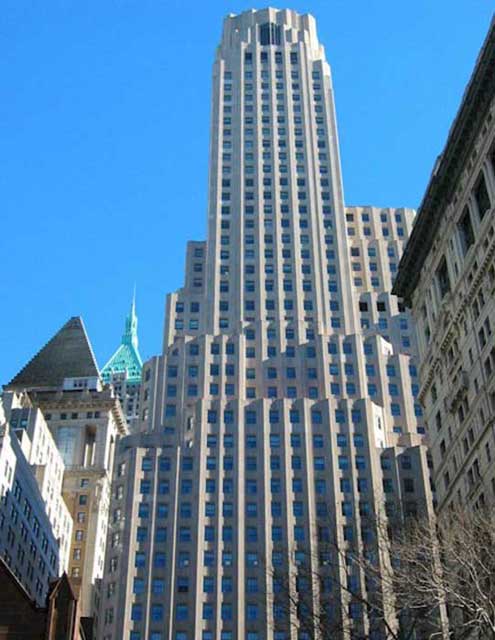
I fell off this building in 1988 while conducting a facade survey. Safety harnesses are wonderful things.

Thinking like an Engineer

I was walking down a side street, minding my own business as much as that's actually possible in Manhattan, when I saw a young woman struggling to open the door to an office building.* The door was one of a pair of heavy glass doors with no frame, just hidden hinges; she was quite small and - important to note - wearing spike heels.

A lot of commercial building doors have stiff hinges. It's a combination of design (the doors won't accidentally swing open from wind or the difference in pressure between inside and out) and accident (the hinges are never cleaned). The woman pulled normally at first (standing vertically with her arm parallel to the ground), the way one would with an interior door, and nothing happened. Then she simultaneously pulled and leaned back slightly, and still nothing happened.

This is where the narrative switches to geek-speak because I switched to geek-think. She was approaching the problem as one of applying a force to the door, but that wasn't the problem. She needed to balance the force she was trying to apply with her arm and (by leaning back) upper body with a reaction to the ground. Her feet needed to be pushing towards the door with as much force as her arm was pulling, and her shoes made it nearly impossible: the configuration of the human body is such that we push forward with our heels, as in "digging your heels in." There was no way for her to do so on shoe heels that were probably under 1/4 square inch in area. On the other hand, if the door was set up to swing in, she could have pushed back off the balls of her feet and her toes to push forward with her arm.

I suspect that all women who regularly wear spike-heeled shoes understand this from experience, but I've never heard it discussed. As someone with large and partially flat feet, I take the reactive force for granted almost all the time. And, it can be endlessly fun demonstrating Newton's Third Law to people while ice skating.

*I might have been inspired to play Galahad, but a woman leaving the building pushed it open from inside before I was near enough to consider breaking stride to help.